Do you upload my raw DNA to World Genetics?
No. Raw DNA files are read in your browser and converted into report coordinates locally. World Genetics does not need to receive or store your raw DNA file for the report to be generated.
Your account can save the generated coordinates so you can reopen them later without storing the original raw DNA file.
Are the generated coordinates real G25?
No, they are not official G25 coordinates, but they are built to be close enough for instant World Genetics reports.
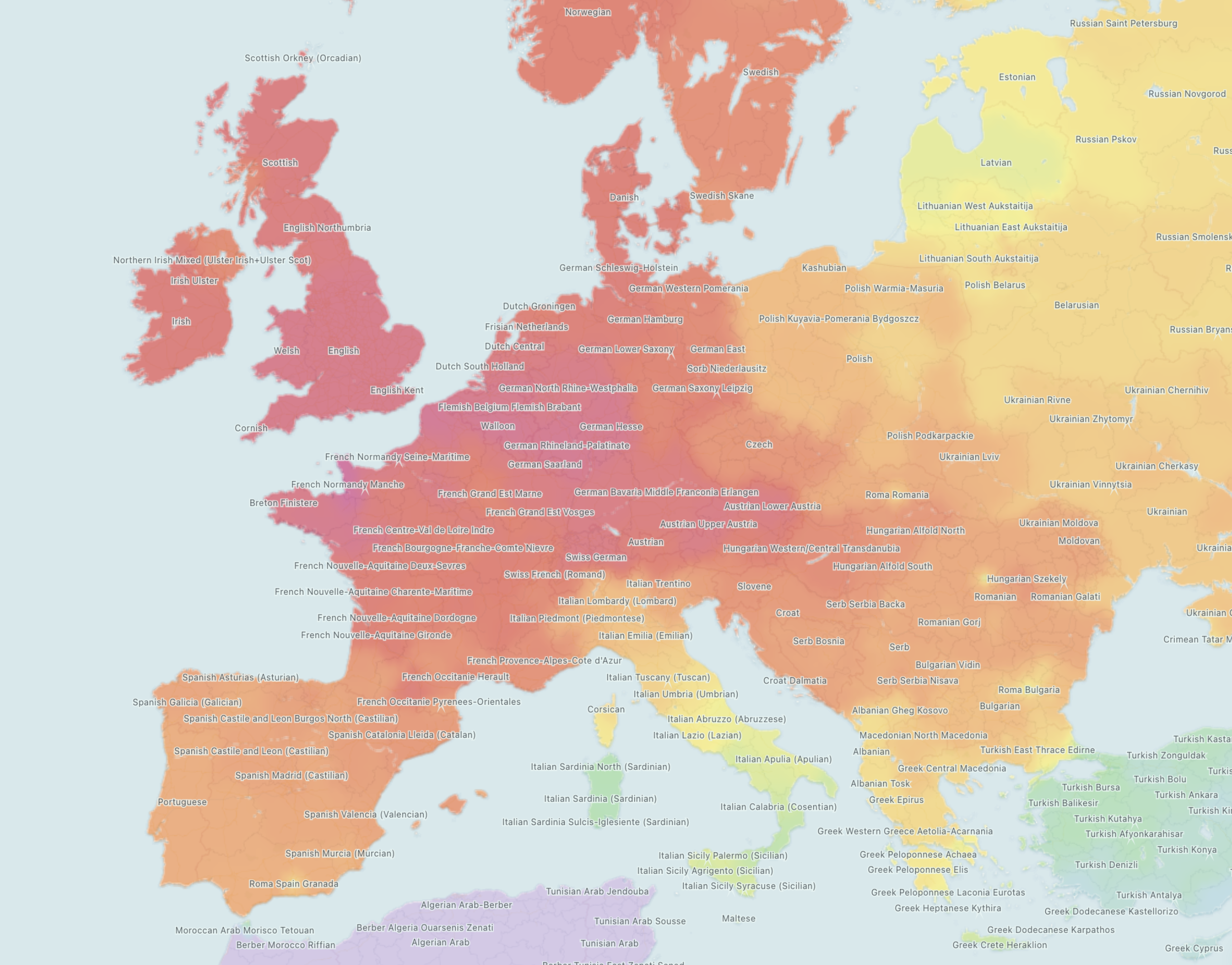
Think of them like a fast conversion into the same general coordinate space: your closest population clusters, broad regional patterns, breakdowns, and heatmap should usually tell the same kind of story, while exact distances and small percentage differences may shift compared with real G25.
If you want official G25 coordinates for deeper comparison work, you can get them here.
Which raw DNA files are accepted?
World Genetics is designed for common autosomal raw-data exports from 23andMe, AncestryDNA, MyHeritage, and FTDNA. Use the original text, CSV, TSV, RAW, DNA, or ZIP export downloaded from your provider account.
Screenshots, ethnicity-result PDFs, family-tree files, and edited spreadsheets are not raw DNA files and will not work.
Can I use World Genetics without a DNA test?
Yes. If you know where your parents, grandparents, or great-grandparents come from, you can create a population-based ancestry estimate instead of uploading DNA.
You choose the closest known origins for each ancestor, and World Genetics builds estimated coordinates from matching reference populations. Raw DNA is more personal, but the estimate is useful for exploring likely closest matches before taking a test.
What do distances mean?
Distances measure how close your coordinates are to a population average or ancient sample in the comparison space used by the report. Lower distances mean closer similarity, but they are not identity labels and they do not prove that you belong to a group.
They are best read as a ranked comparison: very close and close matches are usually more informative than distant ones, especially when several nearby populations cluster together.
Why do results differ from Ancestry or 23andMe?
Large DNA companies usually estimate broad ethnicity categories using their own private models and customer databases. World Genetics focuses on population similarity, regional averages, ancient comparisons, breakdown models, and heatmap exploration.
That means the report may show more specific regional matches, but it is answering a different question: which reference populations your coordinates resemble most closely.
Are ancient matches literal ancestors?
No. Ancient samples are reference points, not direct family-tree proof.
A close ancient match means your coordinates are similar to that sample or group in the model, which can be useful for understanding historical affinity or deep ancestry components. It should not be read as “this individual was my ancestor.”
Can I download my report?
Yes. After generating results, the report page lets you save outputs based on the visible matches, breakdown, and heatmap. You can also save your generated coordinates in the browser and copy them for your own records.
For best long-term access, save your coordinates somewhere private instead of relying only on browser storage.